How to Split Payments Automatically in Your NFT Contract
Start with the split, not the mint page
If you want to split payments automatically in your NFT contract, make that decision before you write the sale logic, not after the mint is live and money is already landing in one wallet. This is where a lot of teams get sloppy. They spend weeks on artwork, metadata, whitelist flow, reveal mechanics, then treat team revenue like an awkward accounting task for later. Bad move. Once ETH or stablecoins start hitting your contract, every manual payout becomes an extra task, an extra trust assumption, and an extra chance for drama.
Payment splitters exist to remove that mess. Instead of sending primary sales proceeds to one founder wallet and hoping that person pays everyone correctly, the contract routes funds according to pre-set shares. That means the artist, dev, community lead, treasury, and whoever else gets paid automatically based on rules you define up front. If you are researching payment splitters, 0xSplits, or better ways to handle team revenue, the real goal is simple: make money flow transparently, predictably, and without weekly spreadsheet arguments.
Choose the model that fits your NFT sale
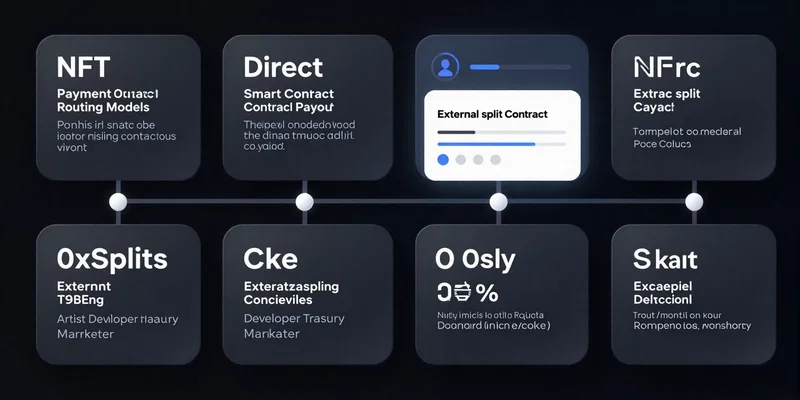
There are two common ways to handle this. The first is to build payout logic directly into your NFT contract. When someone mints, the contract immediately sends the right percentages to each recipient. That sounds neat, but it adds complexity to the mint flow. More external calls. More room for edge cases. More gas concerns. And if one recipient is a contract with weird behavior, the whole transaction can get annoying fast unless you design carefully.
The second, and usually cleaner, model is to send proceeds from the NFT contract to a dedicated split contract. That split contract holds and distributes funds based on fixed percentages. This is where tools like 0xSplits have become popular. They let you create a split once, assign recipients and ownership percentages, and then point your NFT contract at that split address as the payout destination. Your mint contract stays simpler, your team revenue logic is modular, and if you use an established splitter system, you benefit from infrastructure that has already been tested in the wild. For most creator teams, that separation is worth it.
How to wire an NFT contract to a splitter without making it brittle
Here’s the practical version. Your NFT contract needs a payout address. Instead of making that address your personal wallet or multisig, make it the splitter. During mint, the contract collects payment, then either forwards funds immediately or lets an authorized function sweep accumulated funds to the splitter. Which option is better depends on your sale design. Immediate forwarding reduces idle balance in the NFT contract. Pulling later can be simpler if you want tighter control over gas and sale-state logic.
If you are writing the splitter logic yourself, use shares rather than floating percentages. Solidity works best when you define allocations in integers, usually basis points or raw share units. For example, artist 5000, dev 2500, ops 1500, treasury 1000. That makes the math explicit and avoids weird rounding habits. Also, think carefully about whether recipients receive funds instantly or claim them later. Claim-based distribution is often safer because one bad recipient address cannot block everyone else. That claim pattern is one reason external payment splitter contracts are so useful: they isolate accounting from mint execution.
The brittle version is the one where your NFT contract hardcodes too much. Fixed arrays you can’t update. Direct transfers that revert unexpectedly. No way to rotate a compromised ops wallet. No event logging for payouts. No treasury address separation. Keep the mint contract focused on minting. Let the payment splitter handle entitlement accounting. The less business logic you bury inside the NFT contract, the easier your system is to reason about under pressure.
Why 0xSplits is popular for creator teams
0xSplits caught on because it solves a very ordinary problem in a very onchain way. Teams need to share revenue. They do not want one person acting like the finance department. They also do not want to deploy a custom revenue-sharing contract every time they launch a collection, soundtrack, game asset drop, or membership NFT. A reusable split primitive is just cleaner.
The nice part is trust reduction. If your NFT contract sends proceeds to a 0xSplits address, everyone can verify the split configuration onchain. That matters more than people admit. Team revenue disputes rarely begin with outright theft. Usually it starts with confusion. Someone thought royalties were included. Someone assumed gas reimbursements came off the top. Someone expected the community wallet to be separate from the founder allocation. A transparent split makes those conversations shorter and less emotional because the payout rules are visible before the money shows up.
There’s also a maintenance benefit. If your project brings in ETH, WETH, or other tokens, a proper splitter setup can standardize claims across assets instead of forcing your team to handle each incoming balance manually. That said, don’t outsource your thinking just because you use a known tool. You still need to decide who gets paid, when, whether a multisig should hold a team share, and how to handle future collaborators. 0xSplits is infrastructure, not governance.
Watch the edge cases that wreck “automatic” payouts
Automatic sounds foolproof until it runs into reality. The first edge case is royalties versus primary sales. People often say they want to split payments automatically in their NFT contract, but they are really talking about mint revenue only. Secondary royalties may be handled by marketplace settings, royalty registries, or not respected at all depending on where trading happens. Don’t promise your team an automatic revenue machine if the backend only covers the primary sale. Be precise about what the splitter receives.
Next issue: upgradability and wallet rotation. What happens if your lead artist loses access to a wallet? What if your legal entity changes and the treasury needs a new address? A rigid splitter can become a liability. Some teams prefer immutable splits for maximum trust. Others want controlled updates through a multisig. There isn’t one correct answer. If trust minimization is the main selling point of the project, immutable is attractive. If the team is operating a long-term brand with staff changes, some upgrade path may be more realistic. Just don’t bury that choice in a dev-only document. Everyone getting paid should understand it.
Then there’s gas. If your mint function tries to do too much, buyers feel it. High gas or fragile execution hurts conversion. This is another reason to keep payout design simple. A separate payment splitter with claim logic often keeps user-facing mint transactions cleaner. And please test with actual scenarios, not just happy-path local scripts. Test partial sales, sold-out conditions, failed recipients, tiny dust balances, ERC20 transfers, paused state, and emergency withdrawal rules. The bugs that matter usually live in the boring corners.
Set team revenue rules like an adult before you deploy
The smart contract can automate math, but it cannot fix vague agreements. Before deployment, write down the exact split and what it covers. Is the artist share based on gross primary sales? Does the ops lead get reimbursed before the split or inside the split? Does the treasury wallet belong to the community, the company, or a multisig controlled by founders? Are secondary royalties split the same way as mint proceeds? If not, where do they go? These questions sound administrative until the first meaningful revenue hits. Then suddenly they are emotional.
A healthy setup usually looks boring on paper. Named recipients. Fixed percentages. A documented payout address. A note on whether you are using a native payment splitter or an external tool like 0xSplits. A statement on whether addresses can be updated and who controls that process. Boring is good here. Boring means no one is improvising distribution logic in a Discord call after mint day.
If you want a rule of thumb, it’s this: keep the NFT contract lean, keep the revenue flow visible, and make team revenue boring enough that nobody needs to “trust the founder” to get paid. That is the whole point of onchain coordination. Not just selling tokens, but removing the awkward human bottlenecks around money.